
5 Reasons Mid-Volume Labs Choose the Abbott Architect c4000 Chemistry Analyzer
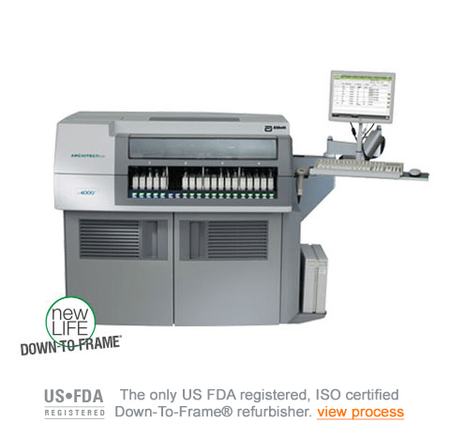
Most chemistry labs sit in an awkward middle. Daily volumes are too high for a benchtop system, but a high-capacity floor model built for the largest core labs would be more instrument than the lab will ever use. When test volume outgrows a small analyzer, the usual result is long queues, repeated reruns, and a growing pile of send-out testing.
The Abbott Architect c4000 is designed for exactly this gap. It is the mid-volume member of the Architect chemistry family, combining photometric, turbidimetric and electrolyte testing on one floor-model platform.
Here are 5 reasons mid-volume laboratories choose the Architect c4000 for routine and STAT chemistry.
1. Up to 800 Tests per Hour on One Platform
The c4000 delivers up to 800 tests per hour, covering photometric, turbidimetric and potentiometric methods. Sodium, potassium and chloride run through the integrated ICT electrolyte module, so a basic metabolic panel or a comprehensive metabolic panel does not need a separate electrolyte analyzer. For labs that currently split chemistry and electrolytes across two instruments, consolidating onto one platform simplifies both workflow and maintenance.
2. Sample Handling Built Around STAT Work
The c4000 holds 100 samples onboard, with 35 priority positions and direct STAT sampling. Urgent samples can be loaded and run ahead of the routine queue without interrupting it. The analyzer accepts sample tubes and sample cups across serum, plasma, whole blood, urine and CSF, and the sample volume range is just 1.5 to 35 µL. Automatic dilution and clot and bubble detection reduce manual reruns, and hemolysis, icterus and lipemia measurement helps the technologist judge sample quality before results are released.
3. 90 Refrigerated Reagent Positions
Reagent management is where chemistry analyzers either save or waste a technologist's time. The c4000 provides up to 90 refrigerated reagent positions plus the ICT module, and Abbott describes its reagents as more than 97% liquid and ready to use. With no reconstitution step, reagents go from the shelf to the instrument without extra preparation. That lets a lab keep a wide routine menu loaded and available instead of swapping packs between runs.
4. Same Architect Software, Carriers and Reagent Cartridges
The c4000 shares its software, sample carriers and reagent cartridges with the other Architect analyzers. Technologists trained on one Architect instrument are already familiar with the others, which shortens training time and keeps inventory simple for labs running more than one Architect system.
It also leaves room to grow. A c4000 can be upgraded with an Architect i1000SR to form an Architect ci4100, so a lab can start with chemistry and add immunoassay later without changing platforms. If you are weighing larger capacity, see our comparison of the Architect c8000 vs. ci8200.
5. Plan the Space, Then Save on the Price
The c4000 is a floor model with a footprint of about 15.6 square feet (49 x 63 x 36 inches) and a weight of roughly 1,132 lb. It needs deionized water at around 15 liters per hour in normal operation, and stores up to 50,000 results with a bidirectional host interface for LIS connectivity. Knowing these requirements early makes site planning straightforward.
Buying new is not the only way to get an Architect. A certified refurbished c4000 provides the same mid-volume platform at a significantly lower acquisition cost, freeing capital for reagents, staffing, or the next instrument.
Right-Size Your Chemistry Capacity
At Diamond Diagnostics, we help laboratories match capacity to real workload instead of overbuying.
Every Abbott Architect c4000 we supply is rebuilt through our Down-To-Frame® refurbishment protocol, then installed and serviced by our own engineers, so your lab starts with confidence in the instrument from day one.