
Abbott Cell-Dyn Emerald vs. Ruby: Choosing a 3-Part or 5-Part Hematology Analyzer
Choosing a hematology analyzer often comes down to one question: does your lab need a compact 3-part differential system, or a larger 5-part system with more automation? Buy too little and you outgrow the instrument within a year. Buy too much and you pay for capacity, space and consumables you never use.
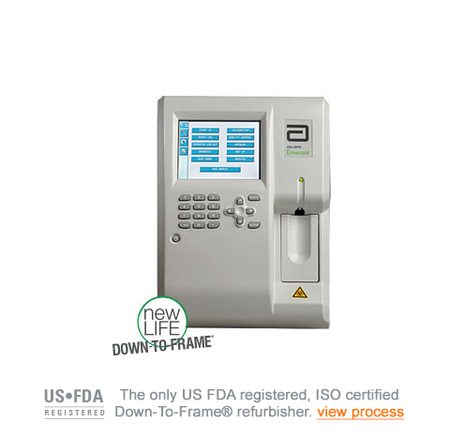
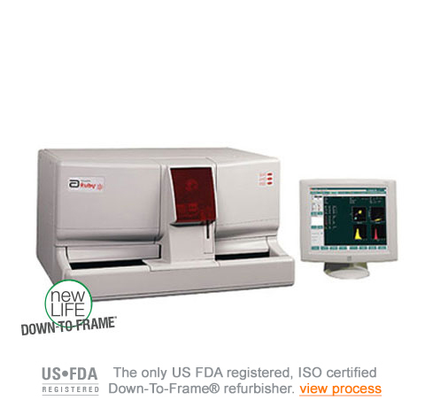
Abbott's Cell-Dyn line answers both ends of that question. The Cell-Dyn Emerald is a small benchtop 3-part analyzer, while the Cell-Dyn Ruby is a larger 5-part system with automated multiple-tube loading.
Here is how the two compare, and which lab each one fits.
Side-by-Side Comparison
| Feature | Cell-Dyn Emerald | Cell-Dyn Ruby |
|---|---|---|
| Differential | 3-part | 5-part |
| Maximum throughput | Up to 57 tests per hour | Up to 84 tests per hour |
| Sample volume | About 9.8 µL | 150 µL minimum (per our product page) |
| Loading | Single-tube, manual | Automated multiple-tube loading, up to 50 samples |
| Size and weight | 35 x 25 x 35 cm, about 9 kg | 77 x 86 x 50 cm, about 105 kg |
When the Emerald Is the Right Fit
The Emerald fits small labs, clinics and satellite sites that need a reliable CBC with a 3-part differential and do not run heavy daily volumes. At roughly 35 x 25 x 35 cm and 9 kg, it sits comfortably on a standard bench. With a sample volume of about 9.8 µL, it is also a practical choice where sample collection is limited.
Day-to-day operation is simple. The Emerald has a color touchscreen, and it stores 1,500 records with histograms internally, or up to 300,000 records on a USB drive. It connects to a LIS over RS232 or TCP/IP, and its QC tools include six control files, Levey-Jennings graphs and Abbott's eQC peer review program. It uses a cyanide-free lyse reagent, and three reagents in total (two onboard).
When the Ruby Is the Right Fit
The Ruby is the better match when volume, or the need for a 5-part differential, outgrows a compact analyzer. It runs up to 84 tests per hour using MAPSS technology, which reports a full 5-part differential, and its multiple-tube loading mode holds up to 50 samples so technologists can load a batch and move on. Optical platelet counts are available on every run, and the Ruby supports both open and closed tube sampling.
The trade-off is space and sample volume. The Ruby is a much larger floor-standing system, and our product page lists a 150 µL minimum sample size. To go deeper on how the Ruby cuts reruns and smear reviews, read 5 Ways the Abbott Cell Dyn Ruby Helps Labs Cut Repeat Tests and Smear Reviews, or see the wider Cell-Dyn range in 5 Reasons Labs Upgrade to Abbott Cell-Dyn Hematology Analyzers.
A Simple Way to Decide
Start with your daily CBC volume and how often your physicians need a full 5-part differential. If most orders are routine CBCs, space is tight and volume is low, the Emerald is usually enough. If you run larger batches, want automated loading, or rely on the extended differential, the Ruby is the stronger long-term choice.
Get the Right Cell-Dyn for Your Lab
At Diamond Diagnostics, we help laboratories match instrument capacity to actual workload.
Every Cell-Dyn Emerald and Cell-Dyn Ruby we supply goes through our Down-To-Frame® refurbishment protocol, including full disassembly, component-level restoration and performance validation.