
5 Ways the Abbott Cell Dyn Ruby Helps Labs Cut Repeat Tests and Smear Reviews
Every repeat test and manual smear review in the hematology department costs technologist time and pushes turnaround time (TAT). Platelet counts that fall back to manual methods, borderline white blood cell (WBC) differentials, and unreliable red blood cell (RBC) indices are classic sources of those repeats.
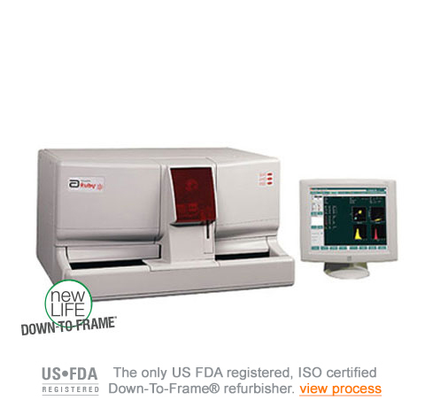
The Abbott Cell Dyn Ruby is a 5-part differential hematology analyzer that Abbott designed for medium-volume clinical laboratories, with optics built to get reportable results on the first pass.
Here are 5 ways the Abbott Cell Dyn Ruby helps labs cut repeats and manual reviews.
1. Optical Platelet Counts on Every Run
The Ruby uses dual-angle optical light scatter to enumerate and size platelets, which Abbott says reduces manual counts and blood smear reviews. Optical platelet counts are available full time, so there is no need to rerun the sample in another test mode.
2. Three-Angle RBC Analysis
Red blood cell counts and indices are measured using three angles of light scatter, cell sphering, and hydrodynamic focusing. That gives technologists accurate RBC results from the same single run, instead of questionable indices that trigger a repeat.
3. MAPSS 5-Part Differential
Multi-Angle Polarized Scatter Separation (MAPSS) technology analyzes white blood cells cell by cell from a single dilution, using four angles of light scatter on up to 10,000 events per cycle. Multiple scatter plots help identify abnormal cells and interfering substances before a result is reported. For a broader look at the family, including the Emerald, see our overview of Abbott Cell-Dyn hematology analyzers.
4. Flexible Loading at Up to 84 Tests per Hour
The Ruby runs both open and closed tube samples, in a manual single-tube mode or an automatic multiple-tube loading mode with up to 50 samples onboard. At up to 84 tests per hour, that covers a steady morning workload while still leaving room for a quick single-tube run when a STAT sample arrives.
5. Simple Daily Maintenance and Open Reagents
Daily maintenance is an auto-clean cycle of about 15 minutes, with weekly manual cleaning of the syringes, shear valve, and diluent/sheath filter, and Abbott includes on-board maintenance videos. The system runs on three core reagents (WBC lyse, HGB lyse, and diluent/sheath) plus a reticulocyte reagent, and Diamond lists it as an open reagent system, which gives labs flexibility in how they source reagents.
Bring First-Pass Hematology Results to Your Lab
At Diamond Diagnostics, we help laboratories upgrade their hematology capability without paying new-system prices.
Every Abbott Cell Dyn Ruby we supply undergoes our complete Down-To-Frame® refurbishment protocol, including full disassembly, component-level restoration, and rigorous multi-level quality control validation, so your lab gets day-one analytical confidence at a significantly lower acquisition cost than a new analyzer.