
Abbott Alinity c vs. Alinity i: Standalone Modules or the Combined Alinity ci?
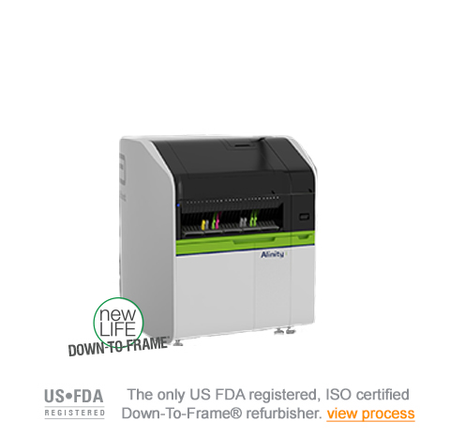

Most conversations about Abbott's Alinity platform jump straight to the combined Alinity ci, the integrated chemistry-and-immunoassay system. But the ci is really two independent modules working together: the Alinity c chemistry analyzer and the Alinity i immunoassay analyzer. Understanding what each module does on its own makes it much easier to decide whether your lab actually needs both, or just one.
Alinity c: The Chemistry Engine
The Alinity c is a high-throughput, floor-standing chemistry analyzer built for automated photometric and potentiometric testing. It processes up to 1,350 tests per hour across whole blood, serum, plasma, hemolysate, and CSF samples, with a broad menu spanning cardiac, toxicology, metabolic, general chemistry, and protein assays. Like the rest of the Alinity family, it supports modular configurations, meaning up to four integrated units can be scaled together as testing volume grows.
Alinity i: The Immunoassay Engine
The Alinity i handles chemiluminescence-based immunoassay testing at up to 200 tests per hour. Where the Alinity c measures chemical concentrations through light absorbance and ion-selective electrodes, the Alinity i detects antigen-antibody reactions, covering hormones, tumor markers, infectious disease markers, and other immunology panels the c module can't run on its own.
Why Sample Volume and Reagent Capacity Differ
Because chemistry and immunoassay testing work on fundamentally different principles, the two modules are built around different tolerances. The Alinity c works with smaller sample volumes (as low as 1.5 μL) and carries a larger onboard reagent capacity, reflecting the higher volume, lower-complexity nature of routine chemistry testing. The Alinity i requires larger sample volumes (2 to 200 μL) to support the more sensitive immunoassay reactions it's designed to detect.
Standalone Modules or Combined Alinity ci?
If your lab's immunoassay testing is already covered by a separate analyzer, or your volume is overwhelmingly chemistry-based, the Alinity c alone may be all you need. If you're bringing immunoassay testing in-house for the first time, the Alinity i fills that gap without requiring a full chemistry platform swap. And for labs that want both under one connected system, the combined Alinity ci runs both modules together at up to 1,550 tests per hour, with shared sample handling and a single operator interface.
Build the Alinity Configuration Your Lab Actually Needs
At Diamond Diagnostics, we help laboratories choose between standalone modules and combined platforms based on real testing volume, not a one-size-fits-all recommendation.
Whether you need the dedicated chemistry throughput of the Abbott Alinity c, the immunoassay capability of the Abbott Alinity i, or the combined Alinity ci, every system we supply undergoes our complete Down-To-Frame® refurbishment protocol, ensuring reliable, audit-ready performance from day one.