
Siemens RapidLab 1240 vs. RapidLab 348 EX: Choosing the Right Point-of-Care Blood Gas Analyzer
Blood gas testing sits at the center of critical care. When a patient is in respiratory distress or experiencing an acute metabolic imbalance, the lab (or the bedside) has minutes, not hours, to deliver actionable pH, pCO2, and pO2 results. Choosing the wrong analyzer for your testing volume creates a bottleneck exactly where you can least afford one.
Siemens Healthineers' RapidLab platform covers this need across a range of throughput and footprint requirements. Two models frequently come up when labs are deciding how to equip a critical care testing site: the RapidLab 1240 and the RapidLab 348 EX. While they share a manufacturer and a core mission, they are built for meaningfully different environments.
RapidLab 1240: Built for Higher-Volume Critical Care
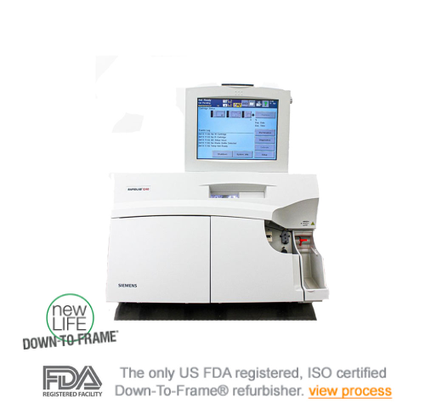
The RapidLab 1240 is part of Siemens' RapidLab 1200 series, engineered for medium-to-high volume critical care testing. It runs a broader panel than the 348 EX, measuring pH, pCO2, pO2, bicarbonate (HCO3-), and electrolytes (sodium, potassium, chloride) from heparinized whole blood, with a result available in roughly 60 seconds.
Because the 1200 series was designed with cartridge-based reagents and Ready Sensor® electrode technology, it minimizes daily maintenance while supporting a higher testing cadence, making it a strong fit for hospital core labs, ICUs, and STAT labs processing a steady stream of samples throughout the day.
RapidLab 348 EX: Compact and Capillary-Ready
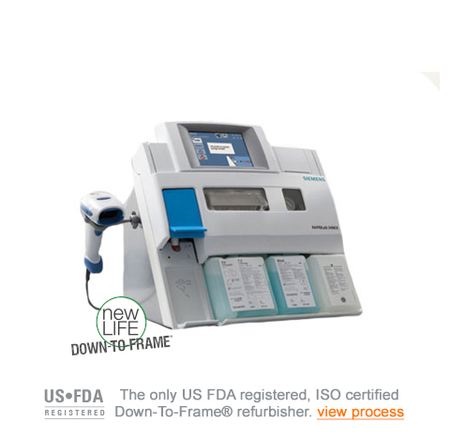
The RapidLab 348 EX is a smaller-footprint benchtop analyzer built for decentralized point-of-care settings. It accepts both whole blood and dialysate samples, including capillary tube sampling, with a minimum sample size of just 50 μL, well suited for pediatric or difficult-draw patients. Like the 1240, it delivers a result in about 60 seconds, but on a smaller test menu focused on pH, pCO2, pO2, and core electrolytes.
Its compact dimensions (roughly 15" x 15" x 14") and lighter weight make the 348 EX a natural fit for smaller ICUs, dialysis units, outpatient surgical centers, or satellite labs where bench space and sample volume are both limited.
Choosing Between the Two
The decision largely comes down to testing volume and physical space. Facilities running higher daily blood gas volumes across a hospital core lab or busy ICU will get more consistent throughput from the RapidLab 1240's higher-capacity design. Smaller units, satellite testing sites, or facilities working with capillary or dialysate samples will find the RapidLab 348 EX's compact footprint and flexible sample handling a better operational fit.
Both platforms share Siemens' reputation for reliable, low-maintenance blood gas testing, so the right choice is rarely about accuracy; it is about matching the analyzer's throughput and footprint to how your facility actually tests.
Equip Your Critical Care Lab with the Right RapidLab System
At Diamond Diagnostics, we help laboratories match blood gas testing capacity to actual clinical demand, without overspending on capacity you don't need or underbuying capacity you do.
Whether your facility needs the higher-volume performance of the Siemens RapidLab 1240 or the compact, capillary-ready design of the Siemens RapidLab 348 EX, every unit we supply undergoes our full Down-To-Frame® refurbishment protocol, guaranteeing point-of-care-ready reliability from day one.