
Roche Cobas c111: A Compact Benchtop Chemistry Analyzer for Low-Volume Labs
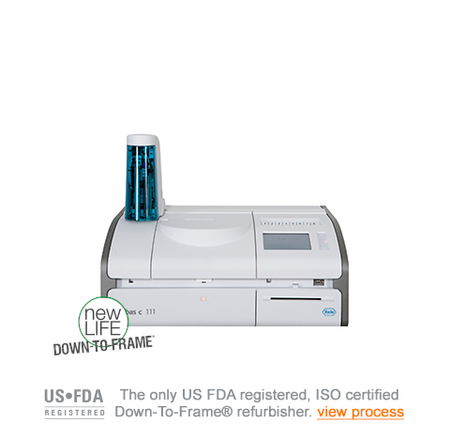
Not every laboratory needs a floor-standing chemistry line. Small hospital labs, satellite sites, outpatient clinics and backup labs often run modest daily volumes, yet still need dependable photometric results for routine panels and urgent samples. Sending that work out adds turnaround delays, while an oversized analyzer ties up bench space and capital the lab does not need to spend.
The Roche Cobas c111 is built for this situation. It is a compact benchtop chemistry analyzer that brings Roche photometric chemistry to labs with low sample volumes.
Here are 5 reasons low-volume laboratories choose the Cobas c111.
1. A True Benchtop Footprint
The c111 measures roughly 59 x 55 x 48 cm (about 23 x 22 x 19 inches) and weighs about 32 kg (70 lb), covering around 0.3 square meters of bench space. A lab can place it on a standard bench without dedicated floor space or reinforced flooring, which makes it practical for satellite labs, clinics and any facility where square footage is limited.
2. Right-Sized Throughput with STAT Sampling
For photometric testing, the c111 delivers up to 85 tests per hour. That is well matched to lower-volume routine work, and it includes priority STAT sampling for emergency and intensive care samples. Up to 8 sample positions with continuous loading let the operator add samples as they arrive instead of waiting for a batch to finish. Samples can be loaded in tubes or sample cups.
3. Optional ISE for Complete Panels
Electrolytes are part of nearly every routine panel. Roche offers an ISE unit as an add-on for the c111, rated at up to 180 ISE tests per hour, so a lab can run sodium, potassium and chloride alongside its photometric chemistry on the same benchtop system. If your menu includes electrolytes, look at the Roche Cobas c111 with ISE. For more on how the c111 compares with larger Roche chemistry systems, read Roche Cobas C-Series Explained.
4. Flexible Reagent Disks for Small Menus
The c111 loads reagents on disks. Each disk holds up to 27 reagent bottles, covering up to 13 different tests, and a bottle yields roughly 50 to 200 tests depending on the assay. That lets a small lab keep exactly the assays it runs most without stocking for a large menu. Diamond lists the c111 as moderate-complexity under CLIA and describes support for routine panels such as basic metabolic panels, comprehensive metabolic panels and liver function tests. If you are planning panels, our guide to the differences between a CMP and a BMP explains which assays each one requires.
5. Photometric Design Built for Consistent Results
The c111 measures at 12 wavelengths between 340 and 659 nm using a halogen lamp and a photodiode array. Reactions run in single-use cuvettes held at 37 °C, which removes cuvette washing from the routine and reduces the risk of carryover between samples. Combined with an overall benchtop design that needs little maintenance attention, it gives small labs consistent day-to-day performance without a dedicated chemistry specialist.
Bring Chemistry Testing In-House Without Overbuying
At Diamond Diagnostics, we help small and mid-sized laboratories choose equipment that fits their workload and their budget.
Each Roche Cobas c111 we supply goes through our Down-To-Frame® refurbishment protocol, including complete disassembly, component-level restoration and multi-level quality control validation, so it is ready for routine use from day one.