
Mastering Electrolyte Analysis: 5 Reasons Labs Upgrade to the Siemens Medical RapidLab

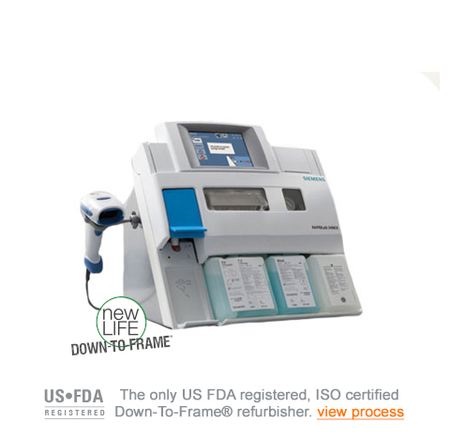
In emergency departments, intensive care units (ICUs), and dialysis centers, patient stability can shift in a matter of seconds. When a physician suspects sepsis, respiratory failure, or severe dehydration, they need an immediate picture of the patient's blood gases and electrolytes.
Waiting 45 minutes for a sample to be spun down and processed on a massive core laboratory chemistry analyzer is simply not an option. Critical care settings require a dedicated, whole-blood electrolyte analyzer that delivers results in under 60 seconds. For decades, the industry standard for this task has been the Siemens Medical RapidLab series.
Here are the 5 reasons why high-pressure clinical environments rely on the RapidLab series for flawless electrolyte analysis.
1. Whole-Blood Testing Eliminates the Centrifuge Bottleneck
Traditional clinical chemistry analyzers require serum or plasma to measure electrolytes. This means a phlebotomist must draw the blood, send it to the lab, and technicians must wait 10 to 15 minutes for the centrifuge to spin the sample down before testing can even begin. The RapidLab series accepts whole-blood samples via syringe or capillary tube, completely bypassing the centrifuge phase and delivering critical sodium, potassium, and chloride results in about 60 seconds.
2. Comprehensive Testing with the Siemens RapidLab 1240
For high-volume ICUs that need maximum data from a single drop of blood, the Siemens RapidLab 1240 is the ultimate workhorse. It does not just perform standard electrolyte analysis; it simultaneously measures full blood gases (pH, pCO2, pO2), co-oximetry, and critical metabolites (like glucose and lactate). This allows emergency physicians to assess a patient's respiratory and metabolic state in a single, comprehensive snapshot.
3. Compact Efficiency: The Siemens Medical RapidLab 348 EX
Not every facility requires a massive, complex co-oximetry menu. For specialized dialysis centers, smaller respiratory clinics, and low-volume ERs, the Siemens Medical RapidLab 348 EX is the perfect solution. It offers targeted, highly accurate testing for essential blood gases and electrolytes. The compact footprint of the Siemens RapidLab 348 EX ensures it can be stationed directly at the point of care, saving valuable bench space without sacrificing OEM-level clinical accuracy.
4. Automated, Zero-Maintenance Calibration
The biggest hidden cost of operating an older electrolyte analyzer is the daily maintenance. Technicians historically spent hours unclogging fluidic pathways and manually calibrating ion-selective electrodes. The modern Siemens Medical RapidLab systems feature self-contained, automated wash and calibration cycles. The machines continually monitor their own electrode health and automatically adjust, ensuring they are always "audit-ready" the moment a STAT sample arrives.
5. Cost-Effective Point-of-Care Scaling
Placing a brand-new blood gas analyzer in every single hospital wing or urgent care branch can quickly exhaust a capital equipment budget. However, decentralizing your testing is critical for fast turnaround times. By partnering with Diamond Diagnostics, hospital networks can acquire certified refurbished Siemens RapidLab units, allowing them to deploy premier point-of-care electrolyte analysis across multiple sites at a fraction of the cost of new equipment.
Upgrade Your Critical Care Laboratory
When treating critically ill patients, your clinical staff cannot afford to second-guess their diagnostic tools. Your facility needs robust, ultra-fast point-of-care equipment.
At Diamond Diagnostics, every refurbished Siemens Medical RapidLab undergoes our rigorous Down-To-Frame® refurbishment protocol. We replace all critical tubing, validate the optical and electrode pathways, and guarantee day-one precision ensuring your emergency department can trust every single electrolyte result.